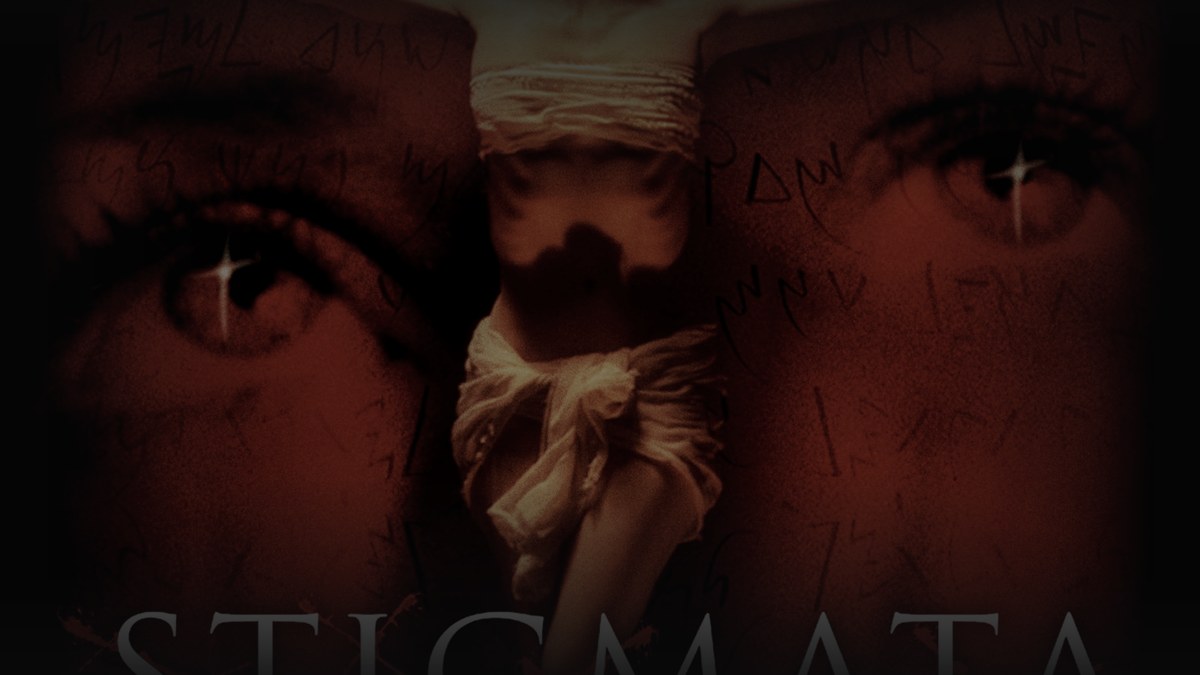
what the film does
frankie page (arquette) is a 23-year-old hairdresser in pittsburgh. her mother mails her a rosary from a flea market. the rosary was stolen from the body of a priest in a small brazilian village where a statue of the virgin mary wept real tears. father alameida, the dead priest, had translated a lost gospel, the gospel of thomas, which the vatican considers heretical. when frankie receives the rosary, she begins experiencing stigmata: wounds on her wrists, feet, forehead, and side that mirror the crucifixion.
father kiernan (byrne), a jesuit scientist who investigates miracles for the vatican’s congregation for the causes of saints, is sent to pittsburgh. he finds frankie speaking in aramaic, writing on walls in a dead language, and bleeding from wounds that appear without cause. he believes her. cardinal houseman (pryce) does not.
why this one
three reasons. first, the style. wainwright came from music videos (michael jackson, nusrat fateh ali khan), and the film is cut like one. the stigmata attacks are edited at MTV speed, with rapid cuts, jump scares, and a sound design that mixes corgan’s guitar drones with the sound of tearing flesh. the effect is disorienting in a way that theatrical horror rarely attempted in 1999. jeffrey l. kimball’s cinematography gives pittsburgh a gothic weight it does not have in reality.
second, billy corgan’s score. the soundtrack includes songs by corgan, natalie imbruglia, and chumbawamba, but the original score by corgan and garson is what gives the film its identity. it is not orchestral. it is guitar-based, ambient, and discordant. the main theme is a four-note descending pattern played on an overdriven guitar that sounds like a prayer being interrupted.
third, the theology. the film’s central claim, that the gospel of thomas represents a suppressed early christian tradition, is a real academic argument (the gospel was found at nag hammadi in 1945). the film dramatizes the conflict between institutional religion and personal faith in a way that resonates regardless of belief. frankie is an atheist who receives the most intense religious experience in the film. that contradiction is the point.
what stays with me
the bath scene. frankie is in the bath when the first wounds appear. she does not scream. she raises her hands out of the water and watches the blood spread. the camera holds on her face. she is confused, not afraid. that moment of quiet confusion is scarier than any jump cut in the film.
on hand
the dvd is the MGM home entertainment release in the canon.
image: tmdb poster (id 10307); genuine film poster. baked at factor 0.45, 1200x675